


“We have often heard that beauty is in the eye of the beholder. This is usually taken to mean that the sense of beauty is utterly subjective; there is no accounting for taste because each person’s taste is different. The statement has another, more subtle meaning: if our style of looking becomes beautiful, then beauty will become visible and shine forth for us.”
‘Divine Beauty: an invisible embrace’, J.O’Donohue, 2003
What does original beauty look like?
The oldest cultural form of the celebration of beauty within both the human form and the divine is effigy. In many ancient cultures, effigies were made as a form of worship of those human characteristics people most valued within their cultures. Early effigies were concerned with a form of organic female beauty, with heavily exaggerated features symbolic of nurture, fertility and comfort.
How do we portray beauty in contemporary society? Is beauty more than skin deep?
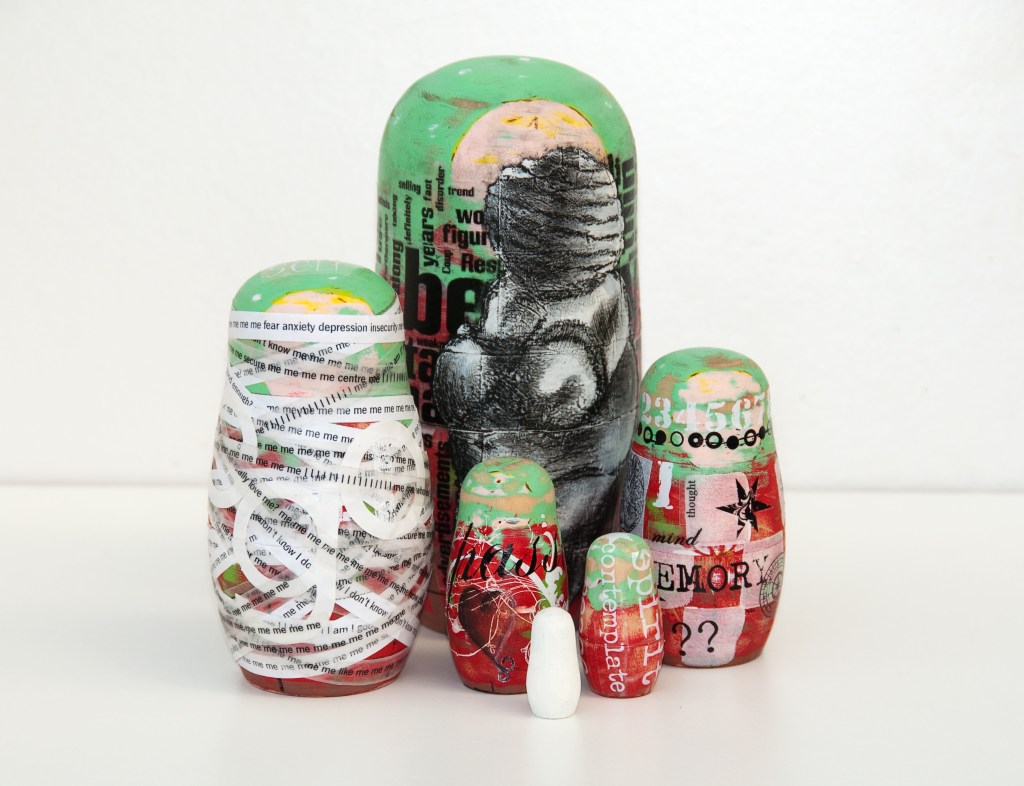
A homage to the ancient original effigy of female beauty, the Venus of Willendorf, Effigy was an interpretive piece exploring social beauty standards and how we see ourselves. It was created using Babushka nesting dolls to represent our external and internal layers and their relationship to what makes us beautiful internally vs what we show as beautiful – or feel we should show – externally. These layers also define our identity and what it means to be human: mind, body and soul.
Unpacking the Babushka doll is like stripping away the surface, external layer and journeying through our inner psyche, ultimately revealing our inner depth. The rounded form of the dolls is similar to that of ancient goddess effigies such as the Venus. Each nested doll represents a layer, an aspect of self, and illustrates the characteristics that define beauty within that layer.
In descending order;
- Body – the outer layer that we publicly present to the world
- Ego – the layers of words we wrap ourselves in as we filter both what comes in and what we allow to come out
- Mind – the quiet, thoughtful centre of our logic and reason
- Heart – vulnerable and delicate, full of wild passions and emotions
- Soul – still, centred and peaceful
- Essence – the pure, innocent and untouched core of our being
Effigy was created for an online group exhibition at Salon Diplomatika, 2011. Contributing artists were asked to respond to the notion of “Original Beauty”.
Materials
- Wooden Babushka doll, altered
- Charcoal
- Rub on lettering and stencils
- Inkjet prints
- Magic tape
- Acrylic paint
 The Artful Bea