
My name is Bea. I’m a multi-disciplinary, medium-fluid artist and experience designer. I’m also a musician, storyteller, educator and professional facilitator.
What if… we could use art and creativity to help people connect more deeply to nature and each other, collaboratively solve problems and envision a different, more compassionate future?
I’m on a mission to live a big, juicy, creative life. I use art and creativity to emphasize the importance of play and experimentation in a serious world.

Why do I do this? Why do I think it’s important?
We’re often told that art is not important. That it’s fluffy, insubstantial, esoteric. That it has no value — economically, educationally, intellectually. Successive governments have eroded the arts (and culture) over a long period of time, pulling funding, removing art from education (think STEM vs STEAM) and now abolishing the Department of Communications and the Arts. We are constantly told that to be an artist is not a ‘real job’ or a ‘proper’, fitting vocation as it does not contribute in a meaningful way to society or the GDP.
It can be very difficult to be an artist and a creative spirit in such an actively hostile and depressing environment.
But I truly believe that creativity is the heart of building healthy communities, change making and human wellbeing. I believe that everyone is creative and I love connecting people to their own creativity.
Creativity and art are critical tools in human innovation and problem solving. Art is subversive, it is didactic, it challenges us to think differently, to view the world through a different lens and to question the rigidity of the status quo. Art is a powerful tool in promoting and driving change, and in imagining ‘different’ — or better. Art brings us critical and creative thinking tools, without which humanity would not have evolved to the state we have. Critical and creative thinking are the basis for innovation, imagination and problem solving. And art brings people together, both in mindset and in experience.
And I believe that now, more than ever, the world needs creatives, makers, thinkers and artists.

What I aim to do through my art practice is bring people together and build connection and community. I facilitate a process of co-creation and invite people to participate because I believe art is not finished until the audience is participating or contributing to creating the final work.
A key principle in my work is to minimise waste and environmental impact. Wherever possible, materials used in creating my art projects are found, recycled, upcycled and reused.
My art practice is built around four key principles: permission, experience, collaboration and participation. Let’s talk about those for a moment.
Permission: Making accessible, fun art that has a connective function, provides a voice for everyone and welcomes people to create, share ideas and build community.
- Catbus – I’m always surprised at how reluctant we are as adults, to give ourselves permission to play. The thing I hear the most from adults about my art is, “Oh it’s so fun and playful! Kids would love it.” or people ask if I illustrate children’s books. It’s fascinating to me that as adults, we immediately perceive things that are fun, colourful and playful as not for us, but for children. Children will immediately run up to Catbus and want to pat him or get in him for a ride. But adults will often wait to be expressly invited to engage with him, or will only do so once their children have – their children engaging often gives them permission to as well.
As adults, we lose the sense of freedom to explore things that are fun and playful. We feel we should be grown up and sensible, responsible and serious. It’s not adult to like lots of colour; society tell us that neutral tones are the mature form of taste. And so we learn that permission is not granted to adults to enjoy things that are fun, frivolous and playful. I want to challenge that.
Giving ourselves permission to play as adults plays a critical role in human wellbeing, connection, building health communities and problem solving in innovative ways.

Experience: Creating unexpected delightful experiences and imaginative, playful spaces for people to discover, explore and enjoy.
- The Enchanted Forest of Love – The purpose in creating this space was to invite people to explore different forms of love and to consider what this might look like in their own lives and experience. I wanted to provide provocations and stimulus that sparked people’s imaginations and allowed them to delight in the experience.
I’m always surprised and excited by how the audience responds to and engages with these provocations.
For example, one of the most popular spaces was Eros. I had hung a line of lingerie leading towards the space; experimenting with wearing the lingerie became very popular, especially amongst the young men at the festival. I kept seeing different people all over the festival in various pieces of my lingerie! People would wear a piece of lingerie for the day or to a night event and then return it to the forest for someone else to experience wearing it. The young men reported that they found the experience delightful and that it helped them to connect more closely with the women in their lives.

Collaboration: Bringing people together and using creative design thinking to inspire asking questions, thinking differently, imagining better and making change.
- Community totems projects – I like to create artworks that are only completed when the audience is co-creating the work with me. In these projects, I am more of a facilitator than an artist – I provide the framework and the concept, the materials and some guidance for creating the pieces, but the audience creates the finished piece.
Each of these community building projects were designed to be simple and accessible for everyone, and to allow everyone to contribute to building the story of their community. People were invited to create a block to add to the totem that represented their story – what the community meant to them and their sense of belonging within it. Blocks could be painted, mosaic’d, hung with beads, wrapped in fabric or any other form of creative expression people felt like exploring. The blocks could then be added to the central pole in any order to create the community story, and new blocks could easily be added by new members of the community at any time.

Participation: Making engaging art that is designed to be touched, handled and moved through in a public arena and that invites a collaborative response from an audience.
- The Wild Temple of Yam and the Temple guardians – the Totemic Spirit Figures were first created as guardians for the Wild Temple of Yam. The sculptures were originally conceived as an embodiment of the spirit of all indigenous ancestry and of reconnection, a homage to indigenous cultures around the world. There are 12 figures in total, designed to sit in circle. Each of the totemic spirit figures represents an Australian native animal.
They are an invitation for us to consider our own origins, our connection to nature and to this country – our home, our responsibilities to respect the knowledge of our indigenous people and to learn about and care for this country.
The Totemic Spirit Figures are a waste-to-art project. Each sculpture is created out of stacked recycled flower pots, djembes, urns, vases, timber and other found materials. They are glued together with liquid nails, painted with acrylic paint and sealed with a waterproof gloss sealer. Each sculpture features hand-made or found accessories relevant to their characteristics.

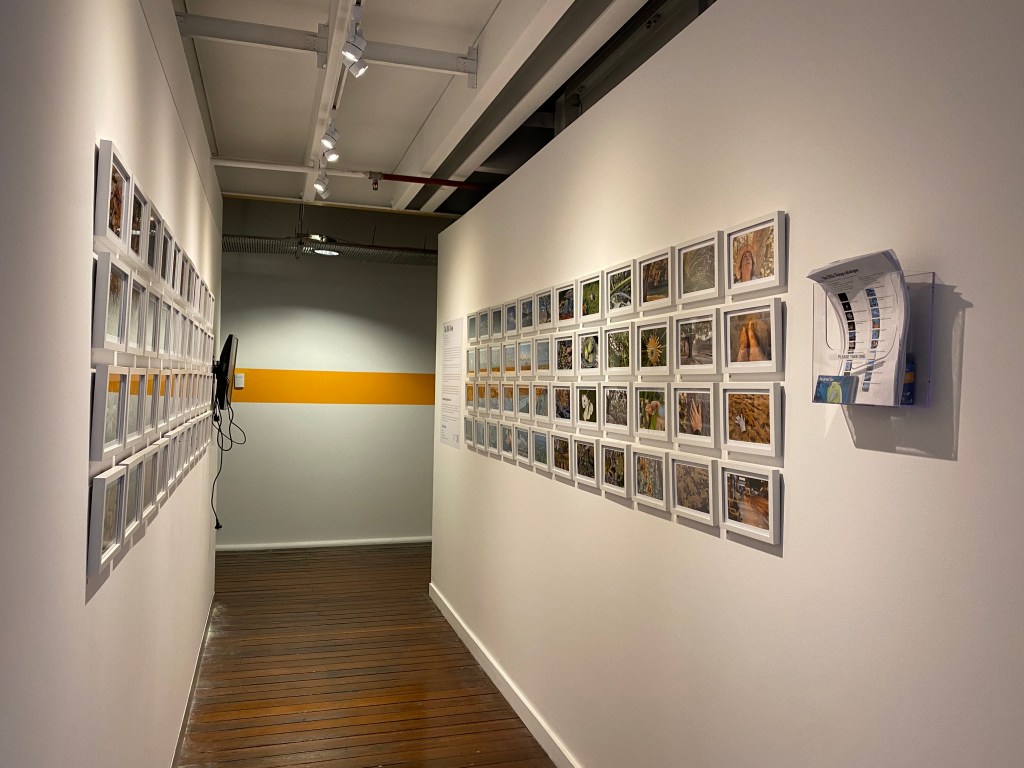
- The Little Things – We’ve all been faced with multiple catastrophic events and enforced isolation over the last few years, resulting in our worlds growing smaller and smaller. When navigating an overwhelming and traumatising world, we seek refuge in the comfort of minutiae and the tenderness of the little things. When we are forced to slow down, to take notice of our immediate environment, to retreat into a smaller world, we discover new interests and unexpected delights in the familiar and find that what is most valuable and important to us changes significantly.
The Little Things is a personal journey, documenting through photographs the little things I noticed – sometimes for the first time, the things I appreciated, took refuge in, was comforted by and that brought me joy. You are invited to contribute to the live feed by uploading an image of a little thing you found comfort or joy in during this time, using the hashtag #thelittlethings2023.
 The Artful Bea