

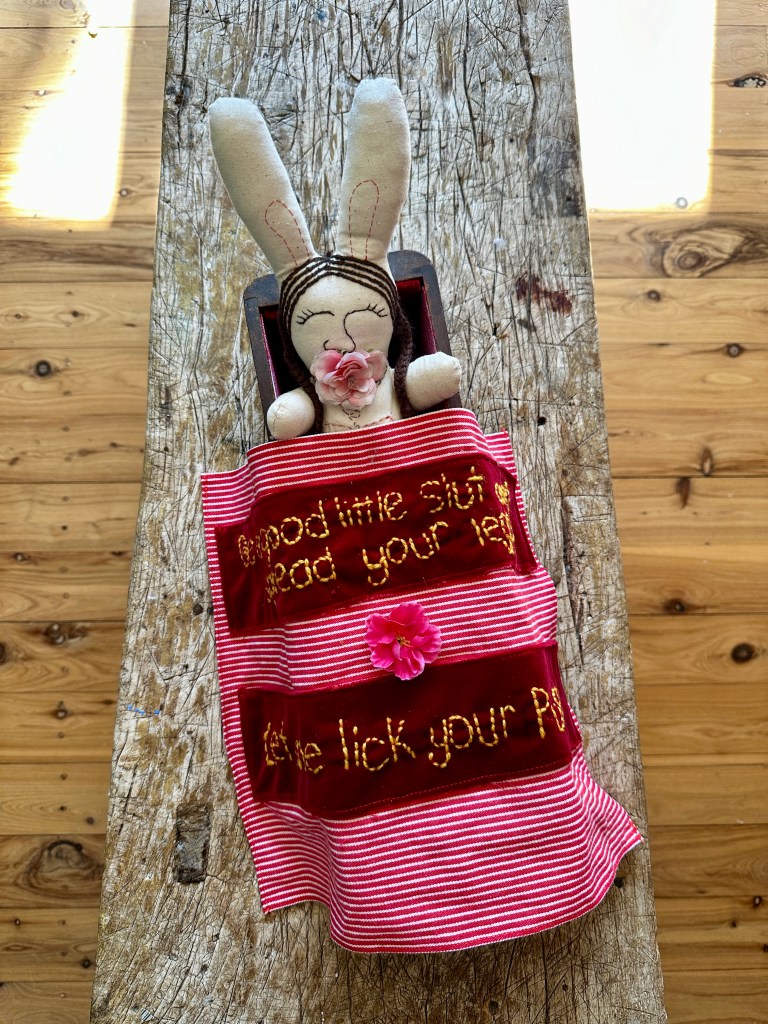
Baby Girl explores the powerful, complicated and transformative moment when a young woman takes control of her sexuality and claims it as her own. Rather than being directed, shaped or defined by others, she is the author of her desire, her identity and her emerging womanhood.
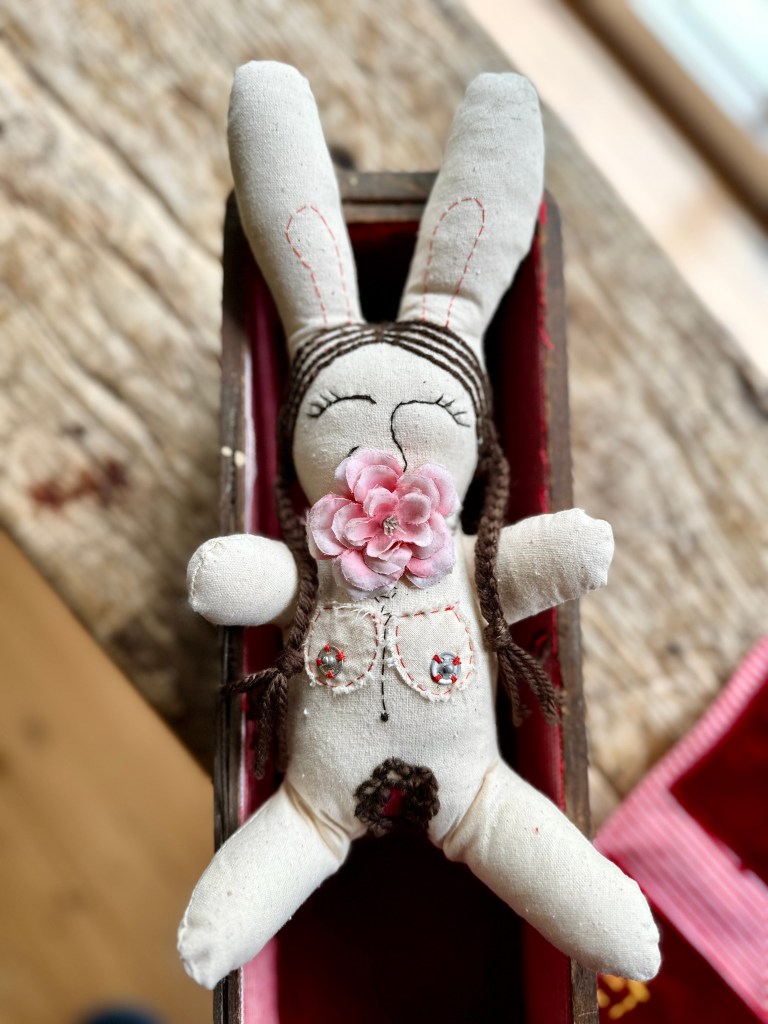
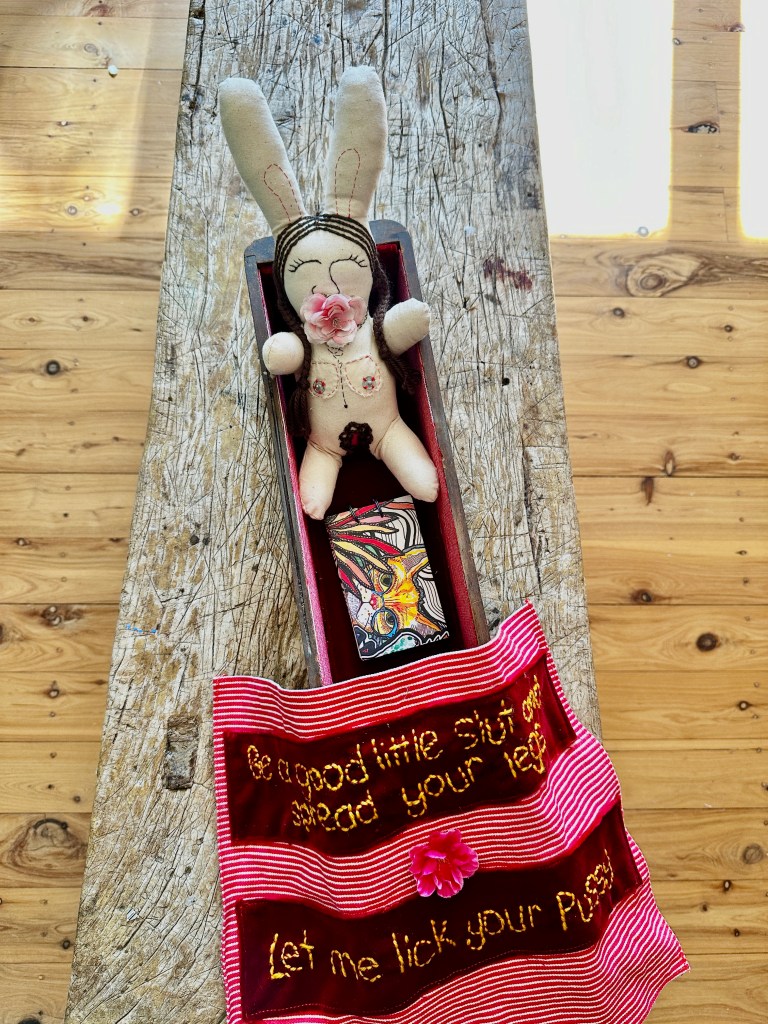
The rabbit-eared teenager reclines with confidence, a blend of innocence and curiosity, transitioning into a space where she chooses exploration over passivity. The bright pink of her exposed sex is not a sign of vulnerability, but of unapologetic ownership and visibility — a declaration that she will not hide, shrink or take up less space for the comfort of others.
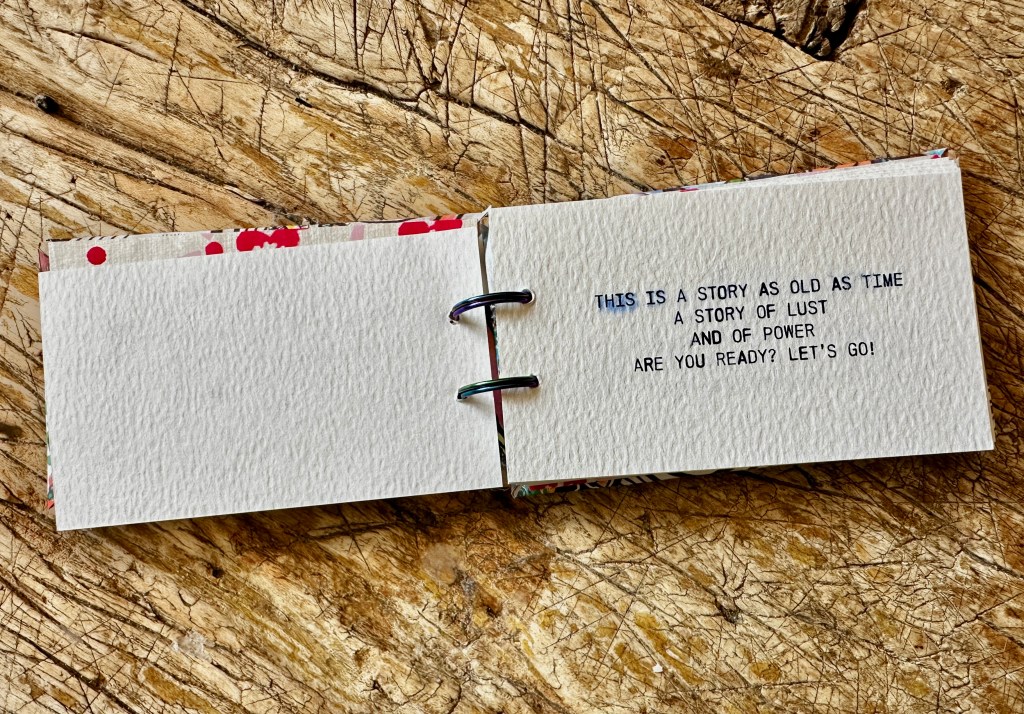
Her eyes are closed not to avoid being seen, but to look inward — to feel rather than perform. Her path is hers to navigate, and she trusts her own instinct before seeking external validation. Her bedtime story feeds her curiosity and the rose in her mouth is a symbol of self-containment: she speaks on her own terms, in her own time, and owes no explanations.
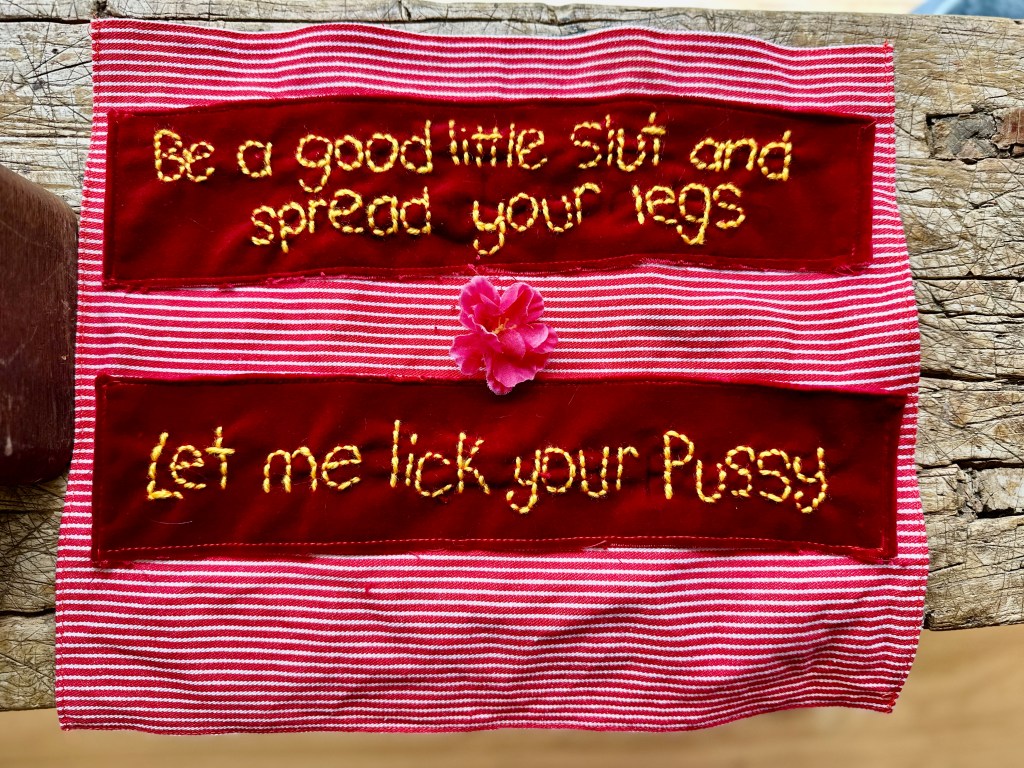
The red velvet lining of the box frames her as precious—not as a commodity, but as something she has the right to value, protect, adorn and offer on her own terms. The embroidered quilt and coffin-like frame reference the structured, traditional boundaries that have historically shaped and restricted women’s sexuality. But here, embroidery—often coded as a domestic craft—becomes an artform reclaimed. What was once the enforced skill of the “good daughter” becomes the cultural inheritance of a woman who will define “home,” “bedroom,” and “womanhood” for herself.
Baby Girl is an act of reclamation. It honours the moment a girl looks clearly at the world she is stepping into and decides: My body is mine. My sex is mine. My story is mine.
 The Artful Bea